

European USDC holders seeking dollars from Circle could have to wait if reserves cannot move between its French and U.S. issuers, even while retaining their claim to a dollar. Circle’s current European redemption policy allows temporary delays during failed reserve rebalancing, exposing a cash-access boundary inside a token that is interchangeable worldwide.
That boundary matters as Circle presses Europe to preserve cross-border co-issuance. Its Oct. 1 response to the European Commission’s MiCA review argues that the structure keeps global stablecoin liquidity within Europe’s regulatory perimeter. The existing terms show what can happen when the reserve transfers supporting that structure cannot be completed.
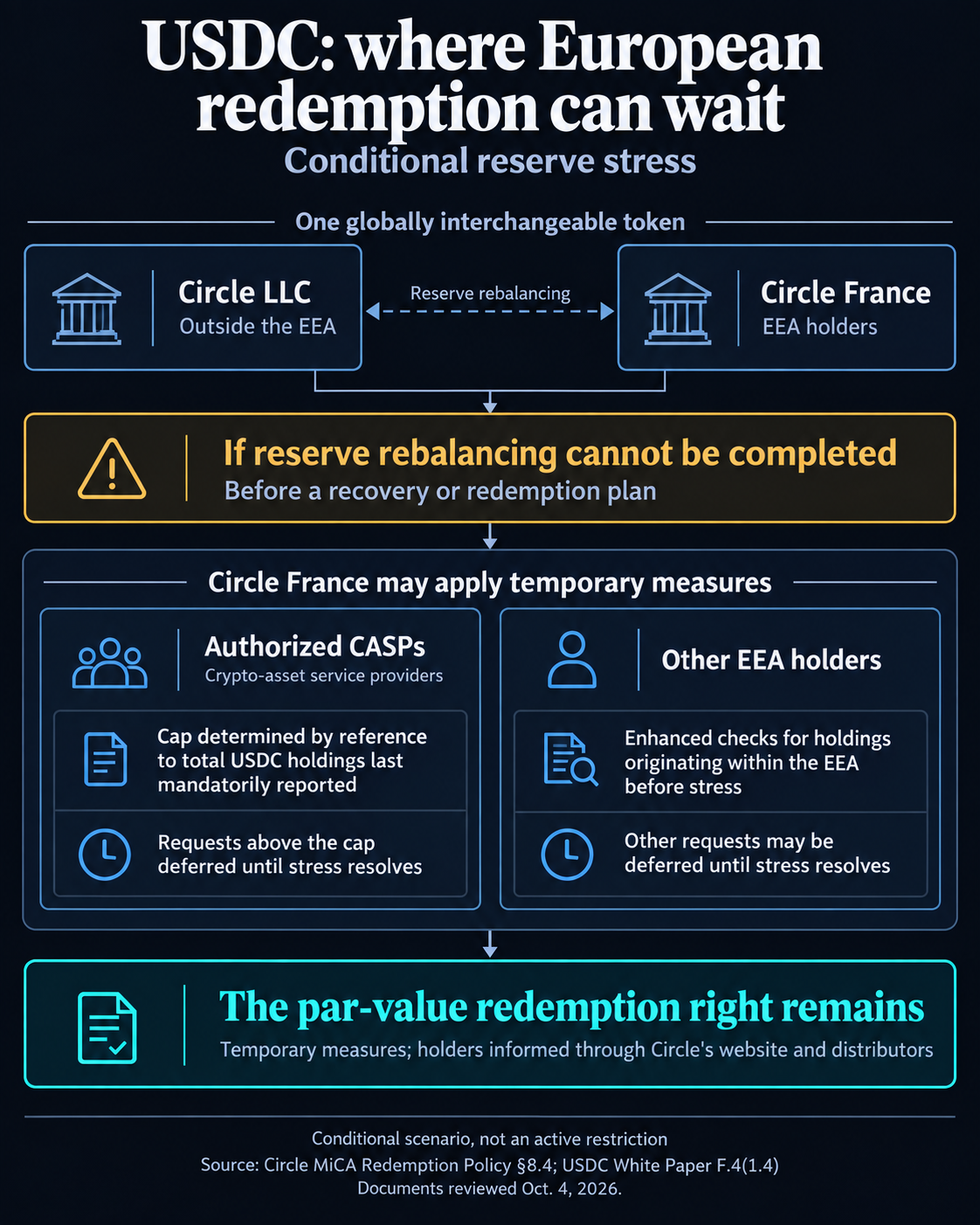
The controls distinguish authorized crypto service providers from other European Economic Area holders. Providers may face a redemption cap based on previously reported holdings; other holders may face checks establishing that their holdings originated within the EEA before the stress began.
These are contingency provisions. The public documents reviewed do not establish an active reserve-transfer failure or an imposed reserve-stress redemption restriction as of Oct. 4. They nevertheless qualify what European users can assume about access to issuer cash during stress.
Under Circle’s MiCA redemption policy, Circle France, formally Circle Internet Financial Europe SAS, handles redemption for USDC holders established in the EEA. Holders established outside the EEA exercise their redemption rights with Circle Internet Financial, LLC under its own agreement.
The policy says that allocation preserves the right to redemption at par under Article 49 of MiCA. For a holder, however, the amount of the claim and the timing of the payment are separate questions.
Circle’s current EEA Mint terms make the timing distinction explicit. A customer may submit a redemption request at any time, but execution remains subject to legal, regulatory, compliance, prudential, liquidity and operational conditions.
The redemption policy is marked Sept. 15, 2026, and the USDC white paper lists an amendment on that date.
Two ways redemption can be deferred
Section 8.4 of the redemption policy defines a Stress Event as a period when USDC reserves cannot be rebalanced between Circle France and Circle LLC, before a Recovery Plan or Redemption Plan is activated. During that period, Circle can adjust the processing and order of redemption requests, including deferring execution beyond ordinary policy timing.
The USDC white paper, in Section F.4(1.4), sets out the holder-specific measures:
- Authorized crypto-asset service providers: Circle France may impose a temporary maximum redemption limit referenced to the provider’s total USDC holdings as last reported under its mandatory reporting obligation. Requests above it would be deferred until the stress is resolved.
- Other EEA holders: Circle France may temporarily restrict redemption to holdings that enhanced checks clearly identify as originating from USDC holdings within the EEA before stress. Other requests could be deferred until resolution.
Circle describes the adjustments as temporary and non-discriminatory, preserving redemption at par. Its policy provides for informing holders through its website and distributing providers. If rebalancing is not restored, redemption is managed under the recovery or redemption arrangements.
The controls can therefore affect both an intermediary seeking issuer cash and an EEA holder seeking to redeem directly. Being able to receive USDC during stress would not, by itself, establish that a non-provider’s new holdings satisfy the pre-stress EEA condition.
A secondary-market sale could still provide an immediate exit while issuer redemption waits, if a buyer or intermediary is willing to pay. The conditional cash-flow implication is that another party must supply the cash before Circle settles. A buyer could purchase the tokens outright using its own liquidity; no loan would necessarily be involved.
An exchange promising to pay before Circle would depend on its own cash arrangements and available liquidity. The token’s continuing par-value claim does not automatically fund that payment. An intermediary choosing to advance cash would take on the timing gap until it could redeem or otherwise dispose of the tokens.
The reviewed documents identify no named intermediary commitment to provide unrestricted immediate cash-outs under this reserve-stress scenario, nor an available stress-market bid or financing cost. A sale would depend on a willing buyer and the terms offered.
Global backing disclosures answer a different question. Circle’s transparency page describes reserve disclosures and monthly third-party assurance of backing.
The white paper describes a French minimum reserve requirement equal to EEA USDC holdings and an inter-issuer rebalancing procedure. That requirement has to accommodate changes in where tokens are held. The paper expressly identifies the risk that Circle LLC cannot rebalance reserves when holdings and redemption requests shift toward the EEA.
The reserve-transfer test behind Circle’s policy case
Circle’s Oct. 1 response recommends preserving multi-issuance and formalizing safeguards, including dynamic rebalancing between global and EU-specific reserves. It argues that restricting the structure would push stablecoin use toward offshore providers and outside MiCA’s protections.
Europe’s systemic-risk watchdog has advanced a different position. In its 2025 recommendation on third-country multi-issuer stablecoins, the European Systemic Risk Board asked the Commission to interpret the existing MiCA framework as not permitting such schemes. If the Commission considered otherwise, it recommended a dedicated framework with safeguards.
Adopted Sept. 25, 2025, the recommendation also called for assessing barriers to reserve mobility and obtaining evidence that supporting institutions can promptly sell assets, transfer funds across borders and retain access to payment systems.
Circle’s terms show why those operational questions matter to holders. Rebalancing is a safeguard when cash can move to the issuer facing redemption requests. When it cannot, temporary restrictions can shift the wait onto service providers and other EEA holders, even while the par-value right continues.
The practical tests are therefore reserve-transfer readiness, the treatment of holders’ requests and any intermediary’s actual cash-out undertaking. Circle’s policy case depends on keeping global liquidity accessible in Europe; its current redemption terms acknowledge the conditions under which European access to that liquidity could slow.
The post Circle can delay European USDC redemptions if reserves cannot cross borders appeared first on CryptoSlate.
Powered by WPeMatico


