

RWA leverage onchain runs almost entirely through variable-rate pools, where the borrow rate is set by utilization rather than by a lender agreeing to a price. Illustratively, Aave’s rate curve lifts the USDC borrow rate from 4% to 14% as utilization climbs from 92% to 100%. JAAA yields between 4.5% and 5% and Maple’s syrupUSDC pays 5.2%, while the one-year average USDC borrow rate on Aave V3 Ethereum is 4.56%, leaving just 50 basis points of spread to work with. The variance in these borrow rates scares off would-be RWA loopers or limits them to double-digit-yielding RWAs, which greatly narrows the accessible universe of investment-grade credit. Coin Metrics found routine daily utilization spikes on a $2 billion pool and the April 2026 KelpDAO rsETH exploit pinned Aave’s USDC pool at 100% utilization, causing borrowers to pay the maximum 14% rate for five days. Since tokenized credit products can take anywhere from T+1 to well beyond T+90 to settle redemptions, a spike like that can outlast the holder’s ability to exit while running an unprofitable trade.
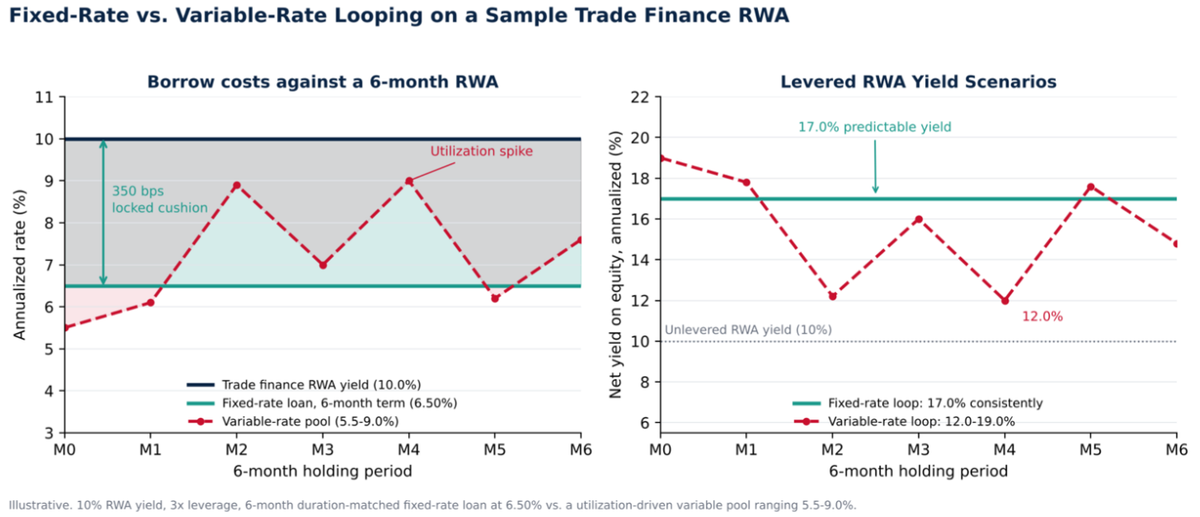
Fixed-rate, fixed-term lending solves this because it lets the allocator match the duration of the loan to the duration of the RWA, the same way a bank extends a 70% advance at a fixed spread against investment-grade paper. Fixed-rate platforms like Tenor Finance, Kamino, Term Labs and Loopscale now quote rates against products, with a Kamino market offering 5.3% fixed-rate loans against Figure’s auto loan portfolio in rolling 30-day terms. Combined with one-click leverage providers, which compress multiple loops into a single transaction, these markets let institutional underwriters size into leveraged RWA positions at scale.
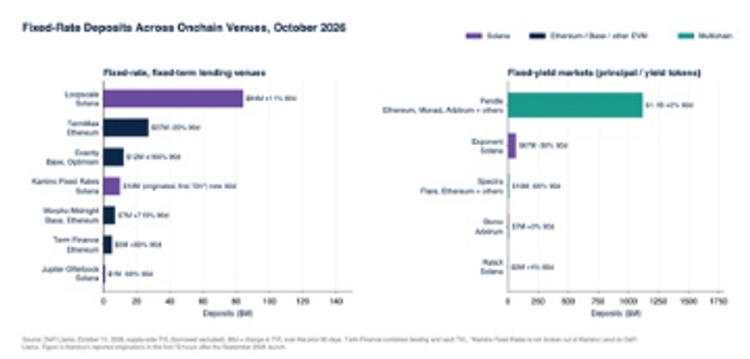
For sizing, a 5% reallocation of the $12 billion in Sky and Ethena reserve capital into fixed-rate looped RWA strategies at 3x is $600 million of equity and $1.8 billion of RWA demand, before foundations, digital asset treasury companies and exchange Earn programs contribute to growth. Well-positioned issuers of underwritten, loopable, non-crypto correlated RWAs will be the beneficiaries as DeFi’s collateral base finally grows beyond crypto.
Powered by WPeMatico


