

Fenris Creations has overhauled manufacturing in EVE Frontier with Digital Chemistry, a system that makes the properties of raw materials you mine in the game determine the performance of the equipment produced from them.
Introduced in the space survival game’s mid-cycle update, the change makes the economy much more complex as manufacturers now have to compete on their knowledge of materials, sourcing and production choices, alongside their ability to gather resources.
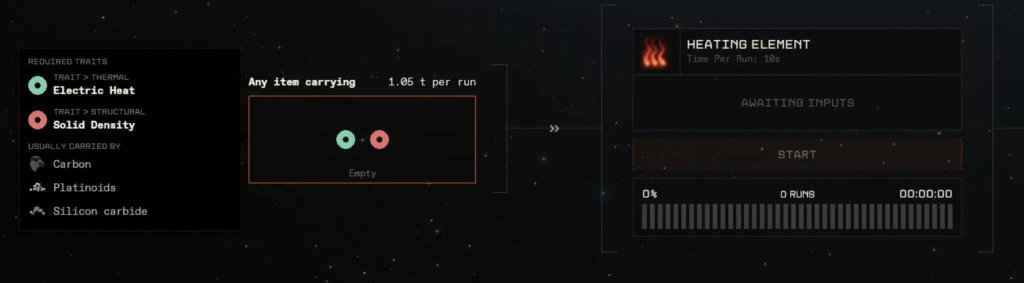
Previously, crafting followed fixed recipes that produced identical items. Under the new system, different batches of the same material can have different properties, including density, conductivity and strength. Those differences carry through the manufacturing process into finished components and modules.
This is illustrated through mining equipment. The properties of extracted silicates influence the optics manufactured using them. Those optics then feed into a lens, whose characteristics ultimately affect mining output, operating cycles and energy requirements.
Consequently, two players using apparently similar equipment could achieve different results because their components originated from different materials.
In this manner, fixed blueprints have been replaced by schemas, which can accept inputs meeting specified characteristics. Manufacturers therefore have greater flexibility to substitute materials, provided their properties satisfy the requirements.
That could also give producers more ways to respond to shortages or changing prices. A material that becomes expensive need not halt production if a suitable alternative is available, although switching inputs may alter the finished product.
Crucially, Fenris has avoided universal quality grades. A property that benefits one component might be unsuitable for another. High density, for example, does not automatically make a material superior.
This creates the possibility of differentiated markets, with buyers seeking particular specifications rather than simply purchasing the highest available tier or the cheapest available item. Manufacturers will likely develop specialisms around supplying components suited to particular activities or customer requirements.
Geography could become more economically significant too. Fenris expects to distribute wider material variations across the universe, potentially giving particular regions advantages in producing certain equipment. For example, the studio suggests exceptional silicates could support superior lenses, whose eventual selling price would also reflect shipping costs.
For players, the resulting calculation would extend beyond whether premium equipment performs better. Its additional output would need to justify the expense and risk of acquiring it.
The change reflects Frontier’s broader economic design, in which fuel consumption makes movement and activity consequential. Transporting valuable inputs requires resources, while dangerous journeys introduce the possibility of losing the cargo altogether.
For alliances, the potential opportunity will be to connect resource discovery, extraction, manufacturing and transport. Access to a useful deposit could become more valuable when combined with the expertise and infrastructure needed to turn it into desirable equipment.
The same update adds the EREV exploration ship, the VATRA hauler and three-dimensional module fitting. Full modular shipbuilding is planned for Cycle 8, with Fenris intending material quality to influence ship sections as the system expands.
Find out more via this introduction.
Powered by WPeMatico


