

Bitcoin price has surrendered the gains from its late-summer rally as declining market liquidity, persistent spot exchange-traded fund (ETF) withdrawals and growing expectations of a Federal Reserve rate hike continue to weigh on investor demand.
Summary
- Bitcoin market depth has fallen nearly 38% from its peak before the Binance hack.
- U.S. spot Bitcoin ETFs have recorded nearly $2.89B in November net outflows.
- Bitcoin holders have realized $8.4B in net losses over the past 30 days.
- Bitcoin long liquidations reached $140M as Federal Reserve rate hike concerns grew.
- Bitcoin’s 300-week moving average offers potential secondary support near $57,700.
According to crypto.news market data, Bitcoin (BTC) was trading at $63,416 at press time, down 1.91% over the past 24 hours and 13.86% over the previous seven days. Daily trading volume stood at $31.9 billion, with the cryptocurrency fluctuating between $62,068 and $64,864.
Bitcoin’s latest decline has brought it closer to the $62,000 region, where buyers have intervened twice in recent days, although mounting losses among existing holders suggest selling pressure has not yet subsided.
Bitcoin market liquidity deteriorates following Binance hack
Bitcoin’s market depth within 1% of its midpoint has fallen nearly 38% from this year’s peak preceding the October Binance hack.
With fewer buy and sell orders available near prevailing prices, large transactions can move Bitcoin’s price considerably in either direction.
The deterioration follows the $6.3 billion Binance hack on Oct. 29, after which Santiment recorded approximately 28,316 BTC in net outflows from Binance-associated wallets through Nov. 5.
Despite weakening market depth, CryptoQuant analyst Arab Chain observed that Binance’s 30-day Bitcoin liquidity ratio had climbed to 0.577, its highest level in five months.
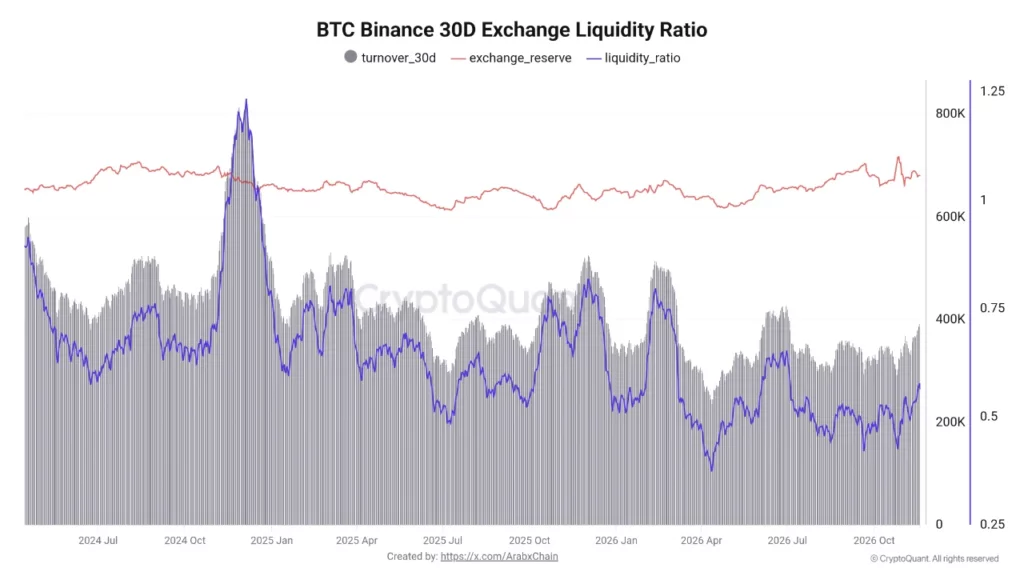
Trading volume over the period reached 392,540 BTC against exchange reserves of approximately 680,250 BTC. However, the indicator measures turnover relative to reserves and does not establish whether sufficient orders are available to absorb large transactions.
“However, a rising ratio does not necessarily indicate increased selling pressure,” Arab Chain explained.
Bitcoin ETF outflows persist as Fed rate hike concerns grow
Institutional demand remains subdued, with U.S. spot Bitcoin ETFs recording approximately $306.5 million in net withdrawals on Nov. 18, according to Farside Investors.
BlackRock’s IBIT led the withdrawals with $148.7 million, followed by Fidelity’s FBTC at $69.3 million and Bitwise’s BITB at $36.6 million.
The latest redemptions brought November’s cumulative net outflows to approximately $2.89 billion, with withdrawals recorded in 11 of the month’s 13 trading sessions.
Bitfinex previously estimated that third-quarter ETF buyers who entered near $80,070 were sitting on substantial unrealized losses, which now amount to approximately 20.8% at Bitcoin’s latest price.
Meanwhile, the Federal Reserve’s October meeting minutes, released Wednesday, revealed that almost all participants considered “further action to raise the target range for the federal funds rate” likely appropriate under their baseline economic forecasts.
Two participants suggested that a rate increase exceeding 25 basis points could warrant consideration in December if incoming inflation figures proved unfavorable.
Leveraged traders have suffered heavy losses during the downturn. According to CoinGlass, Bitcoin liquidations reached $178.35 million over 24 hours, including $140.03 million in long positions, representing approximately 78.5% of the total.
Bitcoin holders realize $8.4 billion in losses
CryptoQuant analyst Woominkyu reported that Bitcoin’s 30-day net realized profit and loss indicator had fallen to negative $8.4 billion, its lowest reading since the summer.
Between Nov. 15 and Nov. 18 alone, holders realized $5.4 billion in net losses, accounting for roughly 64% of the monthly figure.
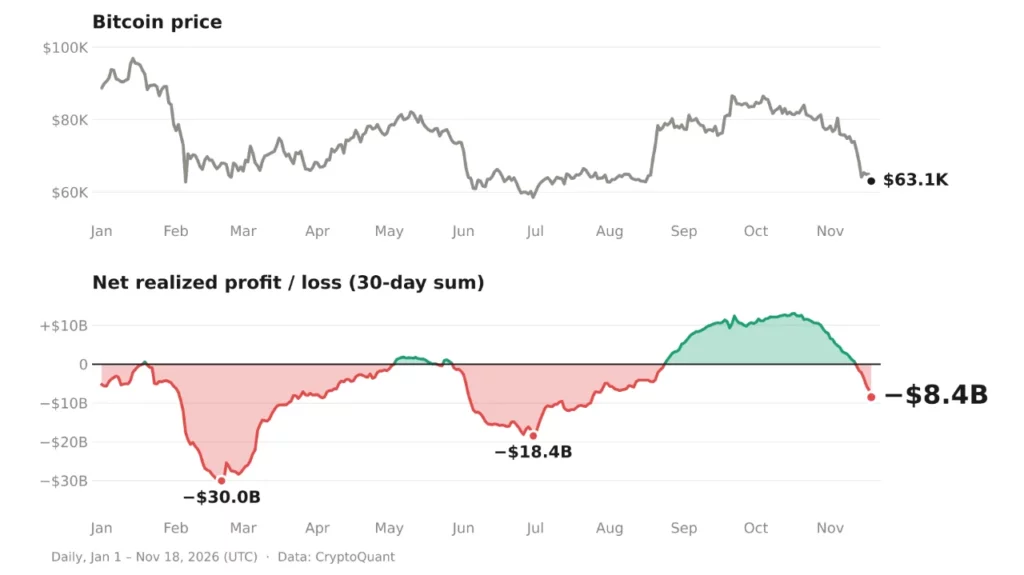
Long-term investors have begun realizing substantial losses as well. The Long-Term Holder Spent Output Profit Ratio fell to 0.73 on Nov. 18, indicating that coins moved by long-term holders were spending at an aggregate loss of approximately 27%.
However, realized losses remain below the $30 billion recorded around February’s market bottom and the $18.4 billion registered in late June.
“Capitulation has clearly started, but by this year’s standards it is still shallow,” Woominkyu said.
The analyst noted that the Coinbase Premium had returned to negative 0.14% on Wednesday, indicating continued weakness in U.S. buying demand.
Can Bitcoin price hold $62K and avoid a return to $57K?
Bitcoin’s daily chart continues to show successive lower highs and lower lows, with the Parabolic SAR positioned above its price at $66,115 and the Awesome Oscillator remaining negative at −11,884.
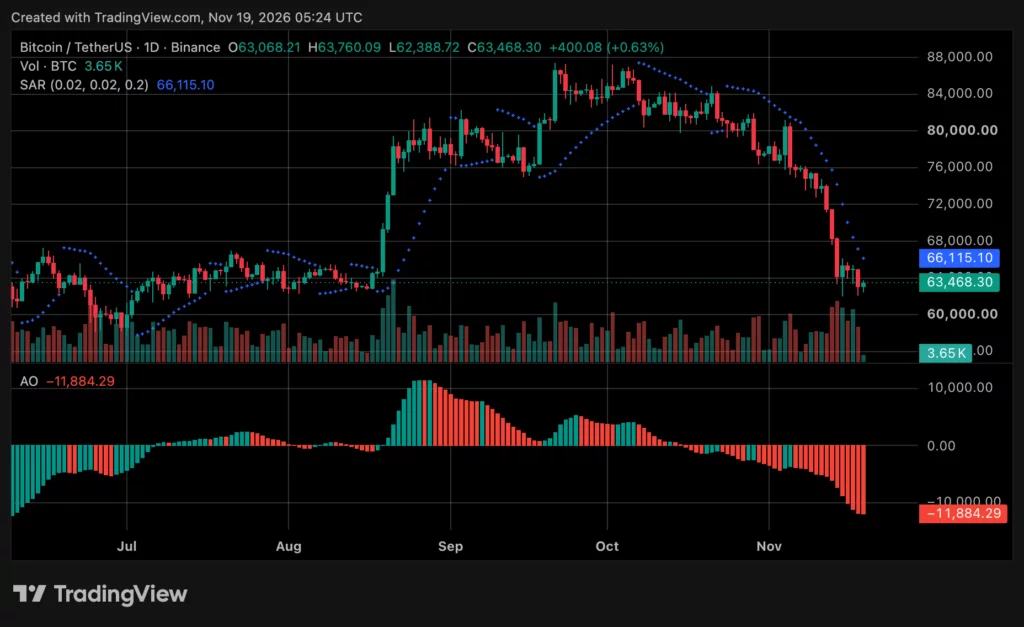
A sustained move below $62,068 could expose the psychological support at $60,000. Analyst Colin Talks Crypto identified another potential support near $57,700, where the 300-week moving average sits close to Bitcoin’s July cycle low.
Conversely, analyst Ali Martinez identified a substantial concentration of previously acquired Bitcoin between $63,111 and $64,373, where approximately 1.22 million BTC last changed hands, based on the UTXO Realized Price Distribution indicator.
Meanwhile, Bitcoin’s earlier $65,398 resistance level remains an immediate obstacle to recovery, followed by the daily Parabolic SAR near $66,115.
Analyst Crypto Varo noted that Bitcoin’s weekly chart had recorded six consecutive bearish candles. According to his assessment, a Sunday close above approximately $65,300 would be required to end that losing streak.
Disclosure: This article does not represent investment advice. The content and materials featured on this page are for educational purposes only.
Powered by WPeMatico


