

Crypto asset manager 21Shares has identified $53,250 as a key downside level for Bitcoin after declining stablecoin supply, withdrawals from cryptocurrency exchange-traded funds (ETFs) and forced liquidations deepened the market downturn following the Binance hack.
Summary
- 21Shares identifies Bitcoin’s $53,250 realized price as a key downside level.
- Stablecoin supply falls $10.7 billion in its biggest 18-day drop since Terra.
- Bitcoin and Ethereum ETFs recorded $3.9 billion in combined net withdrawals.
- Cryptocurrency liquidations reached $5.8 billion in the week ending November 15.
- 21Shares considers deeper Bitcoin declines toward $37,200–$43,800 unlikely for now.
In a November 24 research report, 21Shares researcher Eliézer Ndinga and his colleagues argued that the security breach triggered the initial sell-off but accounted for relatively little of Bitcoin’s subsequent losses.
The firm expects recovery attempts to remain vulnerable until stablecoin balances and institutional demand improve. Meanwhile, Bitcoin traded around $60,424 on November 26, approximately 13.5% above its realized price, based on crypto.news market data.
21Shares links Bitcoin sell-off to $10.7 billion stablecoin contraction
Bitcoin recovered most of its initial losses following the Binance hack, trading at $80,488 on November 4 after falling 5.1% in the two days following the incident.
However, the recovery proved short-lived. Between November 4 and November 11, BTC declined by 8.3% to $73,806 as capital continued leaving cryptocurrency investment products and stablecoins.
The researchers found that stablecoin supply contracted by $10.7 billion following the hack, representing the largest decline in dollar terms over an 18-day period since the collapse of Terra in 2022.
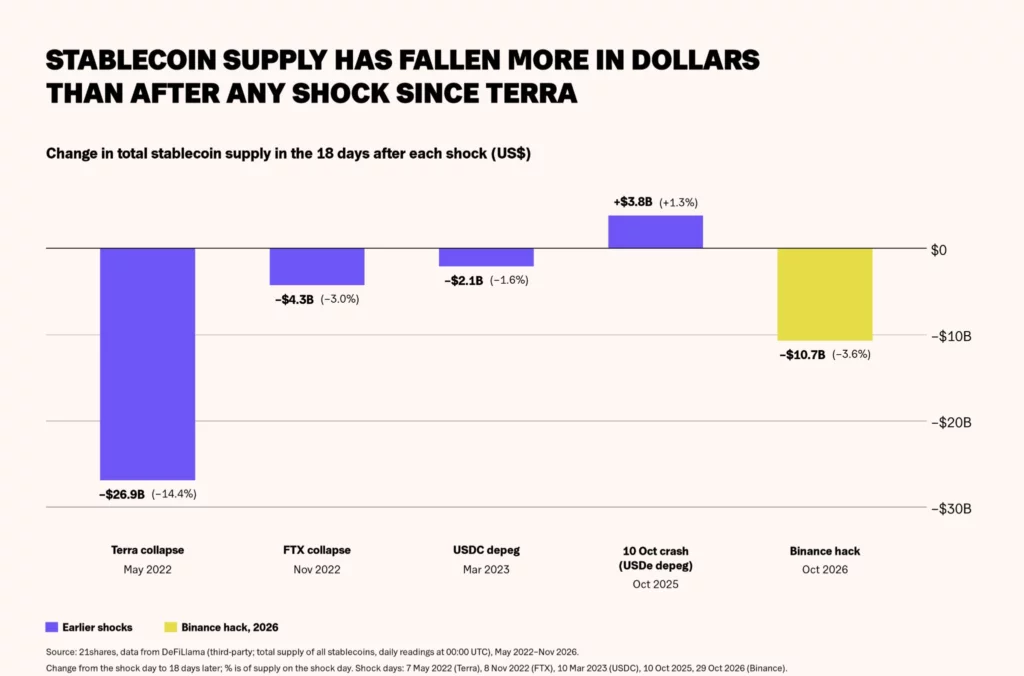
Stablecoin balances held on cryptocurrency exchanges fell 15%, while U.S. spot Bitcoin and Ethereum ETFs recorded combined net withdrawals of $3.9 billion between October 30 and November 13.
Despite the contraction, total stablecoin supply remained only 8% below its May record, compared with a decline of approximately 30% during the 2022–2023 bear market.
As crypto.news reported on November 26, Bitcoin ETF withdrawals have continued, with U.S. spot Bitcoin funds recording $453.12 million in net outflows on November 25, following withdrawals of $231.56 million a day earlier.
Bitcoin liquidations drove the steepest phase of the downturn
21Shares identified forced selling in derivatives markets as the main contributor to Bitcoin’s subsequent decline between November 11 and November 14, when its price fell another 13.5% to $63,821.
Exchanges liquidated $1.6 billion in leveraged Bitcoin long positions between November 12 and November 14, accounting for 92% of BTC liquidations during that period.
Across the cryptocurrency market, weekly liquidations reached $5.8 billion in the seven days ending November 15, with bullish positions accounting for 81% of the total.
Although much of the leverage accumulated following the Binance hack has since been removed, another $671.8 million in Bitcoin long positions was liquidated on November 20 as BTC declined by 4.9%.
Separate research from Glassnode published on November 24 found that Bitcoin’s realized losses relative to capital inflows had nearly doubled within a week, reaching their highest level since the collapse of FTX in November 2022.
Bitcoin could revisit $53,250 as analysts examine historical bear markets
Having fallen below its 200-week moving average near $68,000, Bitcoin would need to reclaim the $73,000–$75,500 region to restore upward momentum, 21Shares said.
On the downside, the researchers identified Bitcoin’s realized price of approximately $53,250 as an important reference level. The metric estimates the average cost basis of circulating Bitcoin using the price at which individual coins last moved on-chain.
During previous bear markets, Bitcoin’s daily closing price fell 61% below its realized price in 2011, 45% in 2015, 30% in 2018 and 24% in 2022.
Applying the 2022 discount to the current realized price would place Bitcoin near $40,400, while a repeat of the 2018 discount would bring it to approximately $37,200.
A less severe discount of 18%, based on the historical narrowing of bear-market discounts, would place BTC around $43,800.
The researchers stressed that the figures are “illustrative levels, not a forecast” and consider such declines unlikely for now, citing the presence of institutional buyers and U.S. spot ETFs that were absent during previous market cycles.
Strategy continues buying Bitcoin despite mounting financial pressure
The report found little evidence that several large Bitcoin holders had contributed directly to the recent selling.
Neither the U.S. government nor the Mt. Gox trustee had transferred Bitcoin to exchanges following the Binance hack during the period examined. Meanwhile, Strategy acquired 2,332 BTC between October 26 and November 15.
However, the company’s financing activities face additional pressure following MSCI’s decision to remove Strategy from several equity indexes after the November 30 market close.
21Shares cautioned that declining demand for Strategy’s common shares could make raising capital for future Bitcoin purchases and preferred stock obligations more expensive.
Strategy repurchased $624.6 million worth of its STRC preferred shares between October 26 and November 15, using proceeds from common stock sales alongside available cash and interest income.
The company maintains $4.9 billion in dollar reserves and cash, which management estimates could cover approximately 3.4 years of preferred stock dividends and interest obligations.
Disclosure: This article does not represent investment advice. The content and materials featured on this page are for educational purposes only.
Powered by WPeMatico


