
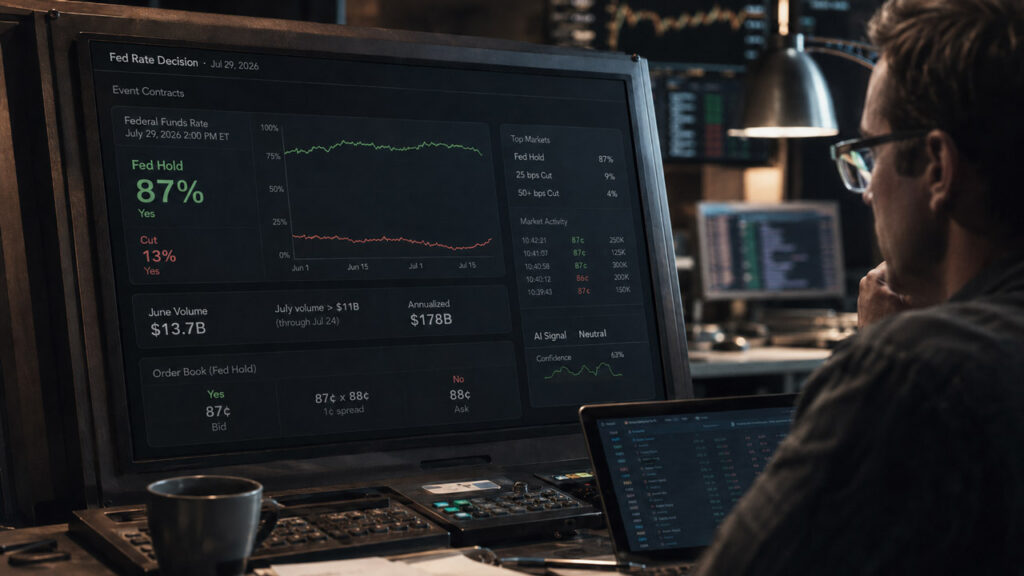
On July 28 and 29, the Federal Reserve meets to set its next rate decision, and traders will try to price the outcome through bonds, currencies, crypto and contracts that settle directly on what the central bank announces.
Reuters polled 104 economists on July 21 and found every one of them expected the Fed to hold at 3.50% to 3.75%.
Kalshi’s July contract puts 87% on that outcome, with roughly $29.7 million in volume on the page, and someone still has to put a price on the other 13%.
That counterparty now includes market makers, quantitative firms, funded-trading shops and AI agents that watch prices, compare related contracts and update probabilities around the clock.
Institutions are testing event contracts, and brokers are wiring in liquidity providers. Funded-trading firms are starting to treat resolved contracts as a way to identify traders, human or algorithmic, who can price uncertainty better than the crowd.
Together, these forces could deepen order books, speed up price discovery, and concentrate the edge among firms with the fastest infrastructure.
Combined monthly volume across Kalshi and Polymarket reached its peak at $13.7 billion in June, with July already registering over $11 billion. These numbers show prediction markets already trading at professional scale.
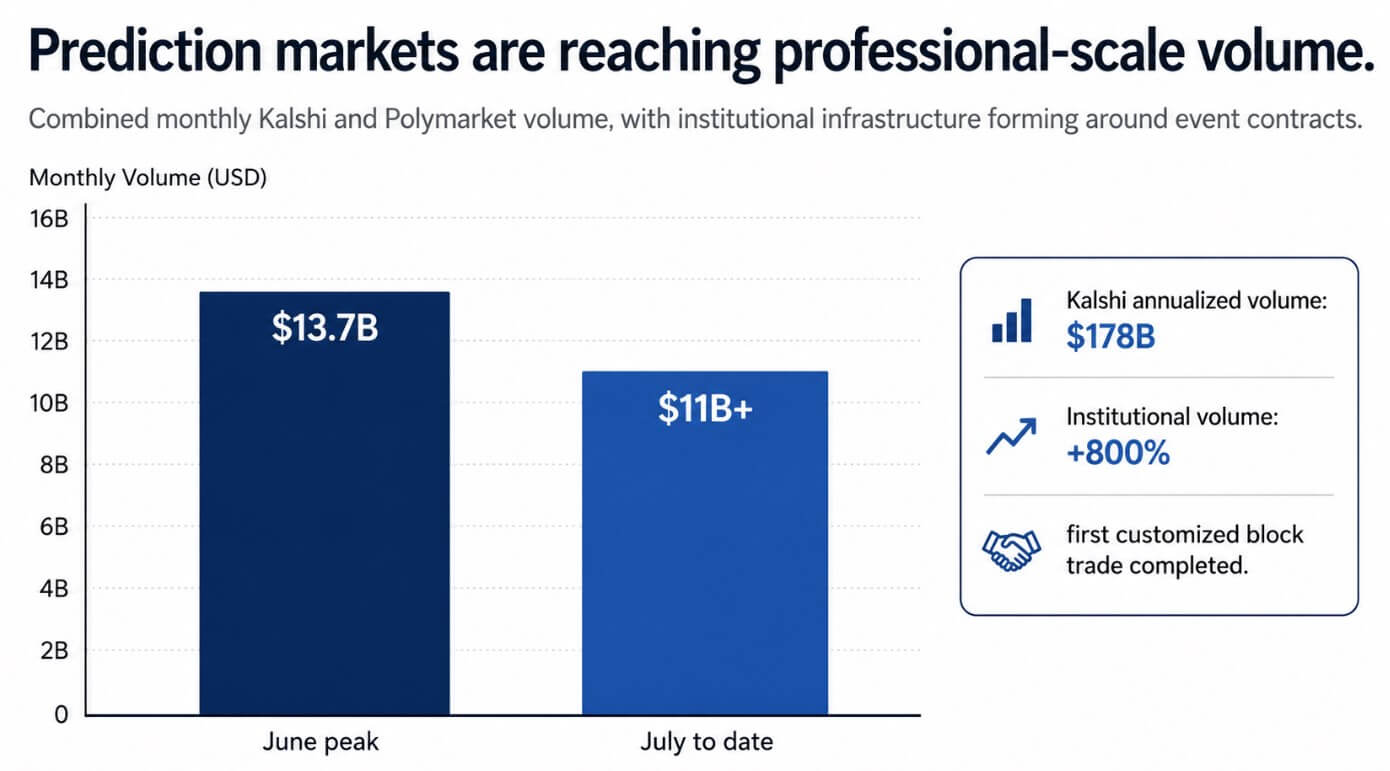
Kalshi said its annualized volume more than tripled over six months to $178 billion, that institutional volume climbed 800%, and that it completed its first customized block trade.
Clear Street, Marex and Jump Trading have each built a piece of the access layer around that growth: Clear Street connects institutional clients to Kalshi, Marex works across both Kalshi and Polymarket infrastructure, and Jump helps institutions reach event markets directly.
AQR, Susquehanna, and OKX have advertised specialist prediction-market roles on top of that build-out.
Corporate treasuries are testing these same contracts to hedge tariff and regulatory exposure, a demand that only works if someone else commits to pricing the other side of the trade, continuously and at size.
Building a functioning market requires a supply side willing to quote both directions, compare related contracts across venues and correct a price the moment it looks wrong.
Measuring the edge
Louis Régis, founder of the on-chain prop firm Propr and a former quantitative trader at Credit Suisse, argued that event contracts make trader selection more rigorous than conventional markets do, as the skill they reward is legible and the risk is bounded.
A contract resolves against a defined outcome, so an allocator can examine whether a trader consistently priced probability better than the market. That test isolates skill more cleanly than a directional profit-and-loss record, where market direction and margin blend into the number.
The Foresight Arena benchmark estimates that detecting a real edge of two percentage points with reasonable statistical confidence takes about 350 resolved binary predictions, and confirming a one-point edge takes roughly four times as many.
A short winning streak on a handful of Fed or election contracts can still come from a favorable market pick, a correlated position, or a rare outcome that happened to land right.
| What a funded firm can measure | Why it matters | Caveat |
|---|---|---|
| Probability calibration | Did the trader repeatedly buy probabilities that resolved too low or sell probabilities that resolved too high? | Needs many resolved contracts to separate skill from luck. |
| Performance after fees and slippage | Shows whether the edge survives real execution costs. | Thin books can make paper edge disappear. |
| Drawdown control | Tests whether the trader can survive bad event clusters. | Bounded downside does not eliminate correlated losses. |
| Market specialization | Reveals whether edge comes from macro, politics, crypto, sports or regulatory events. | Niche expertise may not transfer across categories. |
| Live-capital conversion | Shows whether simulated signals are strong enough to be A-booked. | Nominal funding can overstate actual venue liquidity. |
| Sample size | Foresight Arena suggests small edges need hundreds of resolved predictions to verify. | A hot streak across a few major events is not enough. |
Propr plans to extend its evaluation model to Polymarket, letting traders and AI agents qualify for accounts up to $100,000 and hold as much as $300,000 across multiple accounts, with an 80% profit share once they pass.
The firm treats every trade as a signal, copying some onto the live venue as A-booked positions and simulating the rest internally as B-booked ones, crediting the trader with the identical profit and loss either way.
Right now, Propr copies roughly 5% of its signals onto a live venue. The rest stay B-booked, a holding pattern Régis attributes to collecting enough data to deploy treasury capital responsibly, and payouts settle on-chain in USDC regardless of booking method.
The execution problem
Régis expects AI agents to fit prediction markets especially well: each contract follows a fixed structure, produces an observable price, and resolves against a set rule.
An agent can watch a market and reprice it continuously, minute by minute, and Régis argued that a structured environment plus constant repricing adds up to a genuine trading edge.
The Prediction Arena benchmark gave six frontier models $10,000 each and let them trade autonomously on Kalshi and Polymarket between Jan. 12 and Mar. 9.
The models lost between 16% and 30.8% of their capital on Kalshi, and they averaged a smaller, still-negative 1.1% return on Polymarket. A separate working paper on converting forecasts into profit argues that predictive accuracy only becomes expected profit under a proper betting strategy and enough liquidity to execute it.
Prediction markets may be an unusually clean laboratory for AI traders to test how good the models are at turning forecasts into profitable trades.
The range of outcomes
In the bull case, funded traders, market makers and agents supply enough live capital to tighten spreads, deepen order books and pull Kalshi and Polymarket prices closer together.
A January 2026 working paper examined common contracts across Polymarket, Kalshi, PredictIt and Robinhood. It found that Polymarket often led Kalshi in price discovery when liquidity and trading activity ran higher, and that large directional order flow helped decide which venue moved first.
More live capital could extend that lead across more contracts and compress the gap between platforms.
In the bear case, the edge concentrates in a handful of firms with the fastest infrastructure. Casual traders lose consistently to better-informed counterparties, and liquidity thins out when an event gets hardest to price.
Régis said he is “confident about the direction, not the magnitude.” One funded firm, even a quickly expanding one, is still a small source of flow next to a market that already moves tens of billions a month.
| Scenario | What happens | Who benefits | Main risk |
|---|---|---|---|
| Bull case: professional liquidity flywheel | Funded traders, market makers and AI agents tighten spreads, deepen books and correct stale prices faster. | Institutions, venues, skilled traders and users seeking better prices. | Edge still concentrates, but market quality improves enough to justify it. |
| Base case: professionalization remains selective | The deepest contracts around Fed decisions, elections, sports and crypto get better liquidity, while long-tail markets remain thin. | Specialist traders and venues with the strongest flagship markets. | Most prediction markets remain too shallow for institutional use. |
| Bear case: adverse selection dominates | Faster firms capture mispricings before casual traders can react, and liquidity disappears during hard-to-price moments. | Quant desks, bots and prop firms with superior infrastructure. | Prediction markets become less like crowd wisdom and more like retail flow trading against pros. |
| Black swan: trust or legal shock | A disputed resolution, manipulation episode, or regulatory block slows institutional adoption. | Competitors with stronger compliance or settlement credibility. | Professional capital waits on the sidelines until market rules harden. |
The Fed’s hold on July 28 and 29 is already close to settled before the statement even prints. The contest plays out in the remaining tail, the probability band sitting outside that same consensus, and in the moments once CPI, GDP and payroll data force every contract to reprice.
The Bureau of Economic Analysis publishes its advance GDP estimate July 30, and the July employment report arrives Aug. 7. Each release runs the same competition again: whoever prices the surprise first, or fixes a stale line fastest, keeps the flow.
Pricing those releases correctly, again and again, is what turns a trader or a model into something a funded-trading firm wants to back with real capital.
The post Easy money on Polymarket and Kalshi is disappearing as prop firms deploy AI agents appeared first on CryptoSlate.
Powered by WPeMatico


