

Ethereum price has struggled to recover above $1,800 as sustained institutional withdrawals, selling by large traders and renewed concerns over Federal Reserve monetary policy weigh on the cryptocurrency’s prospects for a recovery.
Summary
- Binance’s seven-day average Ethereum reserves fell to a six-year low of 2.97M ETH.
- Ethereum ETFs recorded $39.8M in outflows for a third consecutive negative session.
- Large Ethereum traders are selling while retail investors continue buying the dip.
- Ethereum’s lower Bollinger Band indicates potential downside support near $1,663.
- Alphractal data identifies potential ETH liquidation clusters near $1,200.
According to crypto.news market data, Ethereum (ETH) traded at $1,802.83 during Thursday’s session, down 0.55% over 24 hours and 12.21% over the past seven days. Its market capitalization stood at $220.36 billion, while daily trading volume reached $10.65 billion.
The latest decline has coincided with Ethereum reserves on Binance falling to levels last seen in November 2020, although declining stablecoin balances on the exchange suggest that the amount of capital available for purchases has weakened as well.
Binance Ethereum reserves fall to their lowest level in six years
In a Nov. 18 analysis, CryptoQuant contributor CryptoOnchain reported that Binance’s seven-day average Ethereum reserve had declined to 2.97 million ETH through Nov. 17, its lowest level since Nov. 2, 2020.
The exchange’s Ethereum reserves contracted by 11.3% over 30 days, compared with a much smaller decline of 2.1% across all monitored exchanges, where combined holdings stood at 14.54 million ETH. Coinbase’s reserves remained relatively unchanged at 3.13 million ETH.
The latest figures follow an earlier report showing that Binance’s Ethereum reserves had fallen nearly 42% since July 2025.
However, the withdrawal of Ethereum from Binance has coincided with declining stablecoin balances. Its seven-day average USDT reserve on the Ethereum network fell to $29.71 billion, placing both indicators within the lowest percentile of their respective readings over the past year.
CryptoOnchain suggested that some Ethereum could be moving into self-custody or staking, although the destination and purpose of the withdrawals remain unconfirmed.
The analyst described both Ethereum reserves and stablecoin liquidity on Binance as being “at multi-period lows, with direction not indicated.”
Meanwhile, Binance’s estimated leverage ratio stood at 0.84, even as Ethereum open interest across exchanges declined 18.2% to $9.53 billion. Falling exchange reserves can raise the leverage ratio without traders necessarily opening new positions.
Ethereum ETF withdrawals continue as Fed rate concerns mount
U.S. spot Ethereum ETFs recorded their third consecutive session of net withdrawals on Nov. 18, with investors pulling $39.8 million from the funds, according to Farside Investors.
BlackRock’s ETHA recorded $17.4 million in outflows, while its staked Ethereum fund lost $5.4 million. Grayscale’s two Ethereum products accounted for the remaining $17 million.
Withdrawals over the past five trading sessions totaled $145.5 million, following November’s first two weeks of heavy redemptions, during which Ether ETFs lost $764.1 million.
Corporate treasury sales have accompanied the institutional withdrawals. Digital asset manager CoinShares disclosed Wednesday that it had sold its entire Ethereum treasury position for $16.6 million, alongside $2.7 million in Solana holdings, to help finance a $40 million share repurchase program.
Outside the cryptocurrency market, the Federal Reserve’s October meeting minutes, released on Wednesday, revealed that almost all policymakers considered further monetary tightening likely appropriate under their economic forecasts.
Two participants suggested that an interest rate increase exceeding 25 basis points could warrant consideration in December if upcoming inflation figures proved unfavorable.
Large Ethereum traders sell as retail investors buy the dip
Alphractal blockchain analyst Joao Wedson observed that Ethereum’s recent decline had been accompanied by selling from traders executing transactions worth between $100,000 and $10 million across multiple exchanges, while smaller participants continued purchasing ETH.
His assessment of potential liquidations on Hyperliquid identified a concentration of leveraged positions near $1,200, leaving the possibility of a deeper decline open.
However, Wedson cautioned that the positioning could change before Ethereum approaches that level.
“However, these liquidation clusters can disappear at any moment, potentially reducing downside pressure and providing relief for ETH,” he explained.
Can Ethereum price defend its long-term support?
Ethereum’s daily chart continues to display successive lower highs and lower lows dating back to early October. The widening Bollinger Bands indicate growing volatility, while the cryptocurrency remains below its declining 20-day simple moving average at $2,067.63.
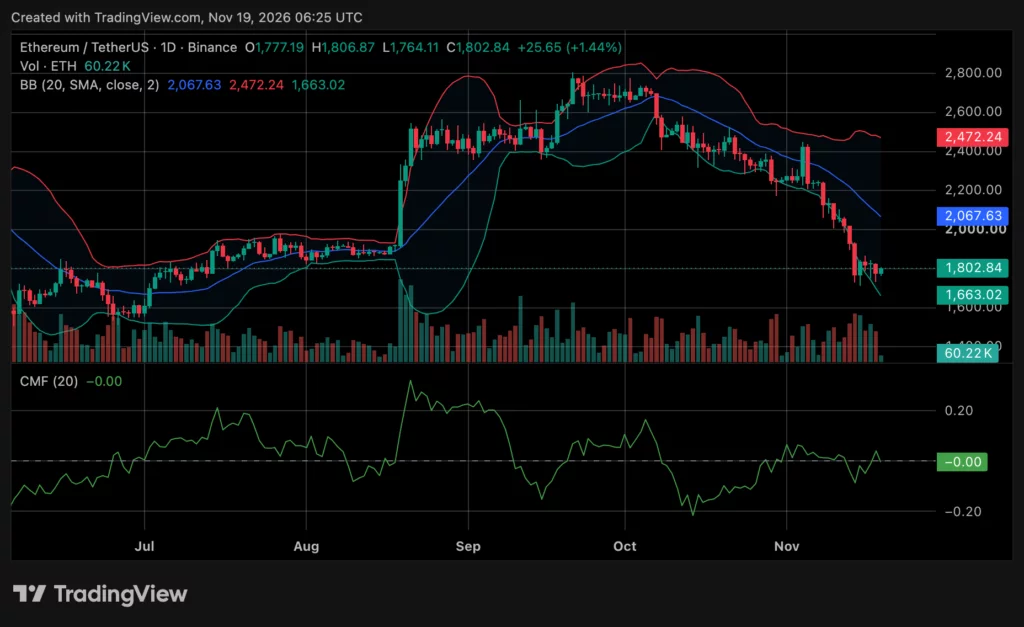
The lower Bollinger Band sits near $1,663, providing a potential downside level if Ethereum fails to defend its recent low around $1,734. A recovery above $1,817 could bring $2,000 and subsequently the 20-day moving average into focus.
Meanwhile, crypto analyst Titan noted that Ethereum had returned to the lower boundary of its long-term ascending channel, with the next weekly candle potentially offering more information about whether the support remains intact.
Analyst Crypto Patel identified a deeper historical accumulation region between $1,000 and $1,500, with $1,000 serving as critical higher-timeframe support. His long-term analysis projects potential expansion targets between $10,000 and $16,000 during the 2027–2028 market cycle.
Powered by WPeMatico


