

Venice pairs a real product, private, uncensored AI used by millions, with a buy-and-burn token and shrinking emissions. VVV touched $21 in June, then pulled back. Here is the bull case, the bear case, and where VVV could head next.
Summary
- Venice is a private, uncensored generative-AI platform, and VVV is its utility token, used to stake for access to the platform’s AI capacity instead of paying per request.
- VVV stands out among AI tokens for real product traction, with more than 2 million users and millions of monthly visits, plus a buy-and-burn model and staged emissions cuts that add deflationary pressure.
- The token reached an all-time high above $21 in early June 2026 before pulling back into the mid-teens, leaving it below that peak but well above its late-2025 lows.
- The bull case rests on genuine usage, deflationary tokenomics, and the private-AI narrative, while the bear case centers on a weak AI token sector, a history of sharp post-rally retracements, and ongoing token emissions.
- A reclaim of the $21 high is plausible if the AI narrative and burn mechanics align, while a break of support near $14.50 would point back toward the low teens.
Venice and its VVV token occupy an unusual spot in the crypto market: an artificial-intelligence project with an actual product that millions of people use, instead of a token attached to a promise.
VVV climbed to an all-time high above $21 in early June 2026, outperforming Bitcoin over the surrounding month, before retracing into the mid-teens as the AI trade cooled. The combination of real traction, deflationary tokenomics, and a volatile AI narrative makes VVV both compelling and difficult to forecast.
This price prediction covers what Venice is, why VVV is trending, the strongest arguments on each side, the technical picture, and bull, base, and bear scenarios. It is not financial advice, and VVV is a volatile token, so the ranges here are wide.
What is Venice, and why is VVV trending?
Venice is a private, permissionless generative-AI application that lets users produce text, images, and code without accounts, data storage, or surveillance. It emphasizes privacy by keeping conversations on the user’s device and encrypting data in transit, and it positions itself as an uncensored alternative to mainstream AI services that filter outputs and log activity.
VVV is the utility token that powers access to the platform. Instead of paying per request, users, agents, bots, and third-party apps stake VVV to unlock a proportional share of the platform’s inference capacity, and staking can also earn income. In effect, holding and staking VVV is how you buy ongoing access to private AI compute.
What makes VVV unusual among AI tokens is that the product genuinely has users. Venice reports more than 2 million registered users and millions of monthly visits, a level of real traction that most tokens riding the AI narrative simply do not have. That usage matters because it connects the token to an actual service with demand, instead of a roadmap.
When an AI token is backed by a product people use every day, the investment case rests on something more durable than sentiment, even if sentiment still drives the short-term price.
The trend in VVV comes from the intersection of that traction with a strong tokenomic design and a hot narrative. The token surged to an all-time high above $21 in early June 2026, part of a broader wave of interest in AI and privacy-focused crypto, and it has remained one of the more actively searched and discussed tokens since.
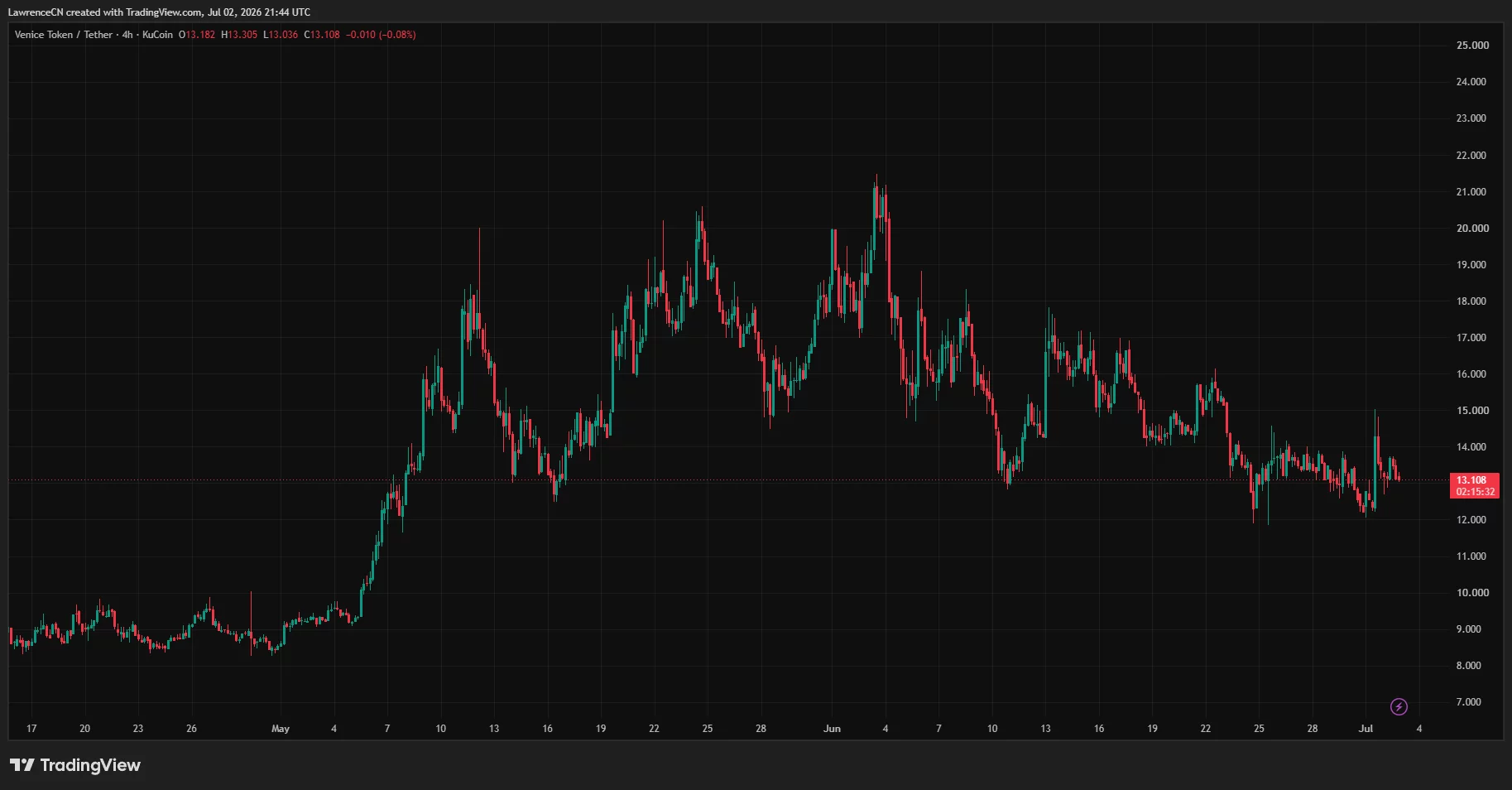
The pullback that followed is typical of parabolic moves, but the underlying story, a real private-AI platform with a deflationary token, is why VVV keeps drawing attention instead of fading into the long tail of AI launches.
The bull case for VVV
The bull case begins with product traction that is rare in its category. More than 2 million users and millions of monthly visits give Venice a genuine, revenue-relevant user base, which is exactly what most AI tokens lack. That usage creates real demand for the token, because access to the platform’s AI capacity runs through staking VVV. As more agents, bots, and third-party applications need private, uncensored inference, they have a functional reason to acquire and stake the token, which ties token demand to actual platform adoption rather than to speculation alone.
The second pillar is the tokenomics. Venice uses a buy-and-burn model, where platform revenue is used to buy VVV and remove it from supply, and it has been reducing token emissions in stages, targeting a sharply lower issuance rate, with a further cut scheduled.
Buy-and-burn plus declining emissions is a deflationary combination: it shrinks or slows the growth of supply while usage-driven demand rises. Compared with AI tokens that rely purely on narrative, VVV’s burn mechanics offer structural support that can cushion downturns and amplify upturns, because the supply side is actively working in holders’ favor.
The third pillar is the narrative and the niche. Private, uncensored AI is a distinct and defensible position in a world increasingly worried about surveillance, censorship, and data control. When the AI narrative runs hot, VVV has shown it can move fast, and its differentiated positioning gives it a story that resonates beyond generic AI exposure.
Sitting within an active ecosystem and maintaining strong trading volume adds liquidity to that story. The bull case is that Venice is one of the few AI tokens with real usage, deflationary tokenomics, and a defensible niche, and that a return of the AI trade could carry VVV back to and beyond its highs.
The bear case for VVV
The bear case starts with the sector. Artificial-intelligence tokens have been among the weaker performers in 2026, and a token is not immune to its category: when the AI trade cools, even fundamentally stronger names like VVV get pulled down. If capital continues rotating out of AI tokens, VVV faces a headwind that its product traction cannot fully offset in the short term, because sentiment and sector flows dominate price action over weeks and months even when fundamentals are sound.
The second problem is VVV’s own volatility and history of sharp retracements. The token has a documented pattern of retracing meaningfully after parabolic moves, and its price history is a series of dramatic swings, including an earlier all-time high, a deep decline to near $1, and then a fresh high many months later. That kind of boom-and-bust behavior means buying after a rally carries real risk of a large drawdown, and the move to $21 was itself parabolic. Entry timing relative to the trend matters enormously for a token that can shed a third or more of its value in a normal correction.
The third pressure is on the supply side, which is a double-edged sword. While buy-and-burn and emissions cuts are deflationary forces, VVV still has ongoing token emissions and does not have a hard-capped supply in the way some assets do, so new tokens continue to enter circulation even as the rate slows.
If usage-driven burns fail to keep pace with emissions, or if platform revenue softens, the deflationary thesis weakens. Add competition from the many other AI and privacy tokens vying for the same narrative and capital, and the bear case is that VVV is a strong project whose token remains hostage to a weak sector, its own volatility, and the need for burns to outrun emissions.
The technical picture
VVV’s chart is defined by its June 2026 peak and the pullback that followed. The token set an all-time high above $21 in early June, then retraced into the mid-teens, a decline of roughly a quarter to a third from the top that fits its familiar pattern of post-rally corrections. Despite that pullback, VVV has held well above its late-2025 lows near $1, and over the surrounding month it outperformed Bitcoin, so the medium-term structure has been constructive even as the short-term move cooled.
The levels traders are watching are clear. On the downside, support sits around $14.50, with a deeper level near $12; losing $14.50 would suggest the correction has further to run toward the low teens. On the upside, resistance stands near $18.30, then around $20.40, and finally the all-time high above $21; reclaiming those in sequence would signal renewed momentum. Momentum readings have been broadly neutral, with the token holding above its longer-term moving average, which points to an intact broader uptrend even during the consolidation. That mix, a neutral short-term posture inside a constructive longer-term structure, describes a token digesting a big move instead of breaking down.
The honest technical read is that VVV is consolidating beneath its all-time high, bounded by support near $14.50 and resistance running up to the $21 peak. As with any volatile token, these levels are guides rather than certainties, and a shift in the AI narrative or the broader market can override the chart quickly.
For a price prediction, the technicals frame a wide band: a hold of support keeps a run back toward the highs on the table, while a break of $14.50 tilts the odds toward a deeper retracement into the low teens.
What could move VVV next
The clearest token-specific catalyst is the emissions schedule and burn rate. Venice has been cutting emissions in stages, with a further reduction planned, and each cut tightens supply. If those cuts land while platform usage and revenue keep the buy-and-burn engine running, the deflationary pressure builds, which is supportive for price.
The metric to watch is whether burns are outpacing emissions on a net basis, because that balance determines whether the token’s supply is actually shrinking or merely growing more slowly.
The second driver is user and usage growth. Because token demand is tied to staking for platform access, continued growth in Venice’s user base, and in the agents and applications that need private inference, translates into structural demand for VVV. Evidence that the more than 2 million user base is expanding, and that more third-party demand is flowing through staking, would strengthen the fundamental case. Stagnating usage would do the opposite, leaving the token more dependent on narrative.
The third set of catalysts is external: the AI narrative and the broader market. VVV is sensitive to how the AI token sector trades, so a rotation of capital back into AI would lift it, while continued weakness in the sector would weigh on it regardless of fundamentals. The ecosystem VVV sits within, and its overall liquidity also matter, as does the macro backdrop that sets risk appetite across all of crypto.
The interplay of tightening supply, growing usage, and a recovering AI narrative is the combination that could push VVV back toward its highs, while the absence of any of them keeps it consolidating or sends it lower.
How VVV compares to other AI tokens
To judge VVV fairly, it helps to place it against the wider field of artificial-intelligence tokens, because that comparison is where its case is strongest and its risks are clearest. The defining feature of most AI tokens is that they are narrative first and product second: they attach a token to the idea of AI, often with little real usage, revenue, or working software behind it.
In a strong AI market, these tokens can run hard on story alone, but they have little to fall back on when sentiment turns, which is part of why the AI token sector as a whole has been weak in 2026. Against that backdrop, the single most important thing about VVV is that Venice is a real, used product, not just a narrative.
That product traction is VVV’s main differentiator. A platform with more than 2 million users and millions of monthly visits generates the kind of genuine demand that most AI tokens cannot claim, and because access to the platform runs through staking VVV, that usage connects directly to token demand.
Where a typical AI token asks buyers to believe a future will arrive, VVV points to a service people already use for private, uncensored inference today. That does not make it immune to the sector’s swings, but it gives it a floor of real utility that narrative-only tokens lack, and it is the reason VVV tends to be discussed as one of the more fundamentally grounded names in the category.
The tokenomics deepen the contrast. Many AI tokens have inflationary or loosely defined supply schedules that work against holders, whereas VVV pairs a buy-and-burn mechanism with staged emissions cuts, actively tightening supply as usage grows. That combination of real demand and shrinking or slowing supply is uncommon among AI tokens and is the structural reason bulls argue VVV can outperform its peers over a full cycle. The catch, as always, is that the burns have to keep pace with ongoing emissions for the deflationary story to hold, so the comparison is favorable but conditional.
The honest conclusion is that VVV screens as one of the stronger AI tokens on fundamentals, but it still lives inside a weak and volatile sector. Being the best house on a bad street helps on a relative basis and offers some downside cushion, but it does not fully protect a token when capital rotates out of AI entirely.
For anyone weighing VVV, the comparison cuts both ways: its real product and deflationary design set it apart from the narrative-only crowd, while its membership in a struggling sector means it can still fall with its peers regardless of how it stacks up against them.
Venice price prediction scenarios
Because VVV is a volatile token whose price depends heavily on the AI narrative and its own supply dynamics, the most honest forecast is a set of scenarios rather than a single figure. The levels below are illustrative reasoning based on the drivers and technicals above, not guarantees, and VVV can move outside these ranges quickly.
Bull case
In the bull scenario, the AI narrative reignites, capital rotates back into AI tokens, and Venice’s user growth continues while its emissions cuts and buy-and-burn tighten supply on a net basis. Demand for staking rises as more agents and applications need private inference, and the deflationary tokenomics amplify the move. In this case, VVV reclaims resistance near $18.30 and $20.40 and pushes back to and potentially beyond its all-time high above $21, with further upside if the supply keeps shrinking against rising usage. This is the reward side of owning an AI token with real traction and deflationary mechanics.
Base case
In the base scenario, Venice remains a strong product in a mixed market, with steady but not explosive user growth and an AI sector that trades sideways. Burns roughly offset emissions, and the token consolidates beneath its all-time high, ranging between support near $14.50 and resistance around $18 to $20 without a decisive breakout. This is a digestion outcome, where VVV holds its medium-term gains and waits for a clearer catalyst from either the AI narrative or its own supply dynamics. Given the current environment, this range-bound path is a realistic central expectation.
Bear case
In the bear scenario, the AI token sector stays weak, capital keeps rotating away from AI, and VVV follows its category lower despite its fundamentals. Usage growth stalls, burns fail to outpace emissions, and the token’s history of sharp post-rally retracements plays out again. Support near $14.50 breaks, and VVV slides toward the low teens or lower, giving back much of its June rally. For a volatile AI token in a hostile sector, this downside is real, which is why timing and risk management weigh heavily on any position instead of any single target.
Frequently Asked Questions
What is Venice (VVV)?
Venice is a private, uncensored generative-AI platform that lets users create text, images, and code without accounts, data storage, or surveillance, keeping conversations local and encrypting data in transit. VVV is its utility token: instead of paying per request, users, agents, and applications stake VVV to access a share of the platform’s AI capacity, and staking can earn income. Holding and staking VVV is effectively how you buy ongoing private AI access.
Why is VVV trending?
VVV is trending because it combines rare product traction with strong tokenomics and a hot narrative. Venice has more than 2 million users and millions of monthly visits, unusual for an AI token, and VVV uses a buy-and-burn model with staged emissions cuts. The token surged to an all-time high above $21 in early June 2026 during a wave of AI and privacy interest, and it has remained heavily searched and discussed since.
Can VVV reach $21 again?
It is plausible but not guaranteed. Reclaiming the $21 all-time high would likely require
the AI narrative to reignite, Venice’s usage to keep growing, and its emissions cuts and
burns to tighten supply on a net basis. VVV would need to clear resistance near $18.30
and $20.40 first. Because the token is volatile and sensitive to the AI sector, it could
return to that level in a strong phase or fall further in a weak one.
How do Venice’s tokenomics work?
Venice uses a buy-and-burn model, where platform revenue buys VVV and removes it from supply, combined with staged reductions in token emissions. Together, these create deflationary pressure by shrinking or slowing supply growth. On the demand side, access to the platform’s AI capacity requires staking VVV, so usage translates into token demand. The key question is whether burns outpace ongoing emissions on a net basis.
What are the biggest risks for VVV?
The main risks are a weak AI token sector that can drag VVV down regardless of fundamentals, the token’s history of sharp retracements after parabolic moves, and ongoing emissions that require burns to keep pace to preserve the deflationary thesis. Competition from other AI and privacy tokens and the token’s general volatility add to the risk, so entry timing and position sizing matter a great deal.
Is VVV a good investment?
That depends on your risk tolerance and research, and this is not financial advice. VVV offers exposure to a rare AI token with real product traction and deflationary tokenomics, but it is volatile, sensitive to a weak AI sector, and prone to large drawdowns after rallies. Anyone considering it should weigh the strong fundamentals against the sector and volatility risks and size any position accordingly.
What levels should I watch for VVV?
On the downside, support sits around $14.50, with a deeper level near $12; a break of $14.50 would suggest a further slide toward the low teens. On the upside, resistance runs near $18.30, then around $20.40, and finally the all-time high above $21. Reclaiming those levels in sequence would signal renewed momentum. The token holding above its longer-term moving average points to an intact broader uptrend.
What could push VVV higher from here?
The main catalysts are the emissions cuts and burn rate tightening supply on a net basis, continued growth in Venice’s user base and in third-party demand that flows through staking, and a rotation of capital back into the AI token sector. A recovering broader market that lifts risk appetite would help too. The combination of shrinking supply, rising usage, and a warmer AI narrative is what could carry VVV back toward its highs.
Disclaimer: This article is for information and educational purposes only and does not constitute financial, investment, or trading advice. Price predictions are speculative scenarios, not guarantees, and VVV is a volatile asset that can lose value rapidly. Nothing here is a recommendation to buy or sell any asset. Always do your own research and consider consulting a qualified financial professional before making investment decisions. Information is accurate as of July 2, 2026, and will change.
Powered by WPeMatico


